Depopulation and near-emptiness of Small Starohorodivka
Grey BeesDepopulation and near-emptiness of Small Starhorodivka shape the village as a place held between abandonment and hoped-for return. Its few remaining residents live among homes whose owners are gone, while Sergey Sergeyich’s improvised delivery of letters turns a largely empty street into a fragile promise that the community might still resume its life.
A Village Marked by Absence
The village’s emptiness is not absolute, but it is enough to transform ordinary spaces. Sergey Sergeyich imagines neighbours’ faces and voices as he walks from house to house, yet knows practically nothing about where they have gone or how they are faring. Their absence is made concrete by the letters he slips into fence-mounted boxes or under doors: the recipients are not there to receive them, so he leaves the post waiting for their eventual return.
The village’s damaged church and the shells that have landed nearby sharpen the precariousness of that hope. Sergey Sergeyich thinks of the church as one of God’s houses, and tries to reassure himself that, apart from the damage caused by one shell, almost the whole village remains intact. His imagined message to the absent residents is an invitation to come back and continue their lives, not a claim that the war has left the place untouched.
Mail as a Substitute for Community
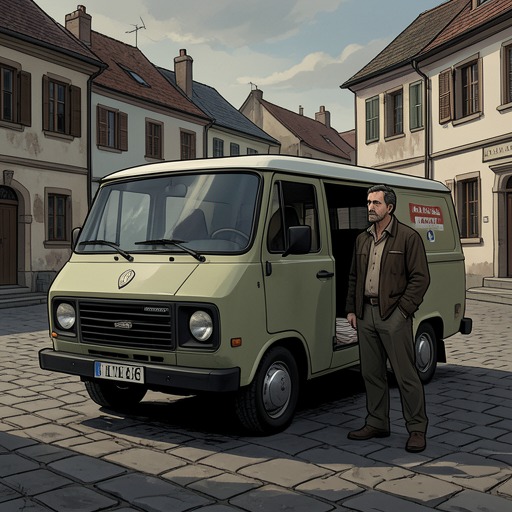
On the day of the Postal Ceasefire, the arrival of a Ukrposhta van briefly makes the abandoned village visible again to the outside world. Sergey Sergeyich stares at the inscription above its cab with joyful surprise. The sight matters because the mail offers a practical link to the neighbours who have left, and because its arrival momentarily restores an ordinary civic routine in a place shaped by war and isolation.
Sergey Sergeyich takes on the work of a postman, sorting the letters by house number and distributing them through the village. He regards the task with pride, as if he were performing the familiar duties of a professional who has received a mailbag from the district. The route gives structure to a day that otherwise seems to drag; delivering each envelope lets him greet his absent neighbours in imagination. He rests briefly at his own house, number 37, after leaving five letters at number 36, then goes out again with another packet.
His delivery does not restore the people themselves, but it gives their homes a continuing place in the village’s social map. By leaving letters for residents who are away, he reverses the usual direction of waiting: the mail will be there for them, rather than the absent residents waiting for it. The gesture sustains the possibility of return without disguising how little he knows about their lives.
Time, Home, and Near-Isolation
The village’s thinning population changes the meaning of home as well as the work of maintaining it. When Sergey Sergeyich asks Pashka about his own house, Pashka says he visited a week earlier and found nothing broken, only the smell of mice. There are no cats left in the village. Even the small exchange about airing out the house turns on the absence of everyday life: Pashka says the air is stuffy for much of the day and that he may go swimming at the quarry beyond Svitle, while the empty house waits for its owner’s return.
For Sergey Sergeyich, the loss of human presence also unsettles time. As he leaves, he suddenly worries that he has left his alarm clock at home. He had wound it the previous evening, and knows it will eventually fall silent; without anyone there to wind it again, he imagines, the house will have no living time until its owner returns. The thought makes the clock more than a household object: its regular ticking depends on the possibility that someone will inhabit the house and keep time there.
His recollection of three years in an abandoned village with Pashka supplies a stark contrast to the crowds he encounters elsewhere. Near-isolation, he reflects, had seemed bearable and even helpful for understanding one’s own life. But among hundreds gathered for a dead man’s return to his native soil, Sergey Sergeyich feels alienated: they are connected by long companionship, while he has no place in their shared grief. The contrast reveals that an empty village can offer solitude, yet the absence of a community also leaves a person without the relationships that make home feel inhabited.
A Fragile Hope of Return
Sergey Sergeyich’s imagined welcome to the villagers depends on an uncertain future: he expects them to come home when the war is over, although he knows neither where they are nor how they are doing. The letters, the houses, and the clock preserve signs of continuity, but none can guarantee that their former occupants will return. Near-emptiness therefore becomes more than a count of who remains; it is a suspended condition in which the village’s ordinary systems still function in fragments, awaiting people who are gone.
The Postal Ceasefire gives that suspension a brief, tangible counterforce. Mail reaches the village, Sergey Sergeyich carries it along familiar streets, and absent neighbours remain recipients rather than disappearing entirely from the life of the place. Yet the quiet that surrounds his work—including the silence of the crows—underscores the scale of the absence. The village persists through small acts of maintenance and imagined reunion, but its future remains bound to the uncertain possibility of return.